Hey Guys,
I'm also using WordPress for ED2230 here is a link to my other blog... http://soymocha.wordpress.com/wp-admin/post-new.php
Thursday, August 16, 2007

Wednesday, August 8, 2007
Lecture 1 and Lecture 2
Group Project Web 2.0
Working together using this wiki
Think of this wiki as a shared online whiteboard. Our entire group can share information using this wiki, making your research accessible to everyone. Notice how you can add comments to a page, see what people have changed, and edit all the text. There is a group responsibility to ensure that the quality of our Web 2.0 Project is up there with the best knowledge available.
Overview of Web 2.0
Web 2.0 is essentially an increasing range of software that supports a variety of technologies for open and collaborative communication, learning and creativity.
It consits of
1. A Platform
This is browser based - e.g. Internet Explorer or Firefox. (Firefox is preferred because it is free and open software in a constant state of development (Web 2.0), whereas Explorer is owned and comes out in a fixed form and then has updates and upgrades on an irregular basis (Web 1.0))
It operates on open and collaborative principles
Communications are the key applications
2. Social Networking
Personalised and open collaborative knowledge spaces
Access people as well as knowledge
Copyright issues exist and have to be dealt with and replaced with a Creative Commons culture
This is beyond the normal formalities of the classroom and can take place anywhere at any time
3. Read/Write Web
People are consurmers of content and services
People and publishers of content and services
Such people are called Produsers
4. What makes Web 2.0
Blogs
Wikis
Social Tagging - bookmarking, Tag Clouds
Sharing sites
Podcasts
Mashups
Aggregators
Ubiquitous connectivity
How to Develop a pbwiki and general thoughts
PB Wiki
· A wiki is an easy-to-use web page that multiple people can edit. It's like a shared whiteboard online. Don't worry about getting IT support or installing any software. We handle all of that. You just start typing and get an online classroom in about 5 minutes.
· Why use PBwiki? No HTML experience required. Create a syllabus, share it with your students, and let them write collaborative essays online. Create online Powerpoint-like presentations right from your wiki.
· Who else is using PBwiki?We host over 135,000 wikis and thousands of others have used PBwikis for their classrooms, from elementary schools to Stanford and Harvard.
o http://mrlindsay.pbwiki.com is Mr. Lindsay's beautiful classroom wiki, where he demos his students' work with book reviews, poems, stories, and tons of other resources. It's a wiki run "by the students, for the students."
o http://cas100b.pbwiki.com is another excellent educational wiki. You'll note the project proposals, class notes, and different sections for different classes.
o http://epochewiki.pbwiki.com is the Penn State English 15 course, which is required for all freshman English students at Penn State.
PBwiki can help you engage with your audiencePBwiki provides educators an easy way to post class room material online and gives students the ability to collaborate through the internet. Check out our video on how PBwiki is helping educators educate.Can't access YouTube? Check out our video through TeacherTube's site here: PBwiki helping educators educate.
Also, be sure to check out the rest of our videos and see what educators are saying about us. See the rest of our PBwiki Educator Videos.
Background Paper references and details on how to set up the Wiki are available on
http://pbwiki.com/edu.pb
A tutorial instruction page ins available in pbWiki
http://ndnetworked.pbwiki.com/FrontPage
Our Web 2.0 Wiki is up and running at
http://ndnetworked.pbwiki.com/ED2033-Web-2
ED2033 Networked Learning Lecture 2.
Review of Lecture 1.
Go to the Wiki
http://ndnetworked.pbwiki.com/ED2033-Web-2
Review the overview of Web 2.0 provided. Copy to your own blog.
Under all the software symbols in this Wiki you will find details about pbwiki and how to find it and use it. Copy this to your blog as well.
You will be allocated to a group to create and work on a wiki together.
These will not be friendship groups rather random groups chosen by the lecturer.
The Wiki will be gradually given more and more structure on which you are to build your understanding and knowledge of Web 2.0
To begin with the following issues are to be explored by your team
i) Qualities of a good virtual team
ii) Team rules for working on our wiki
iii) How do we ensure deep learning occurs
iv) The effective use of multiple medias on the wiki
And
v) Review of the work of writers
a. Marc Prensky
b. George Siemens
c. Diana Oblinger
d. Dana Boyd
And
vi) Flickr
a. An analysis of how it works, why it is Web 2.0 and how it can be used collaboratively.
b. A comparison of Flickr with Photobucket will also provide further insights into the nature of Web 2.0
Hyperlinks, Video clips, podcasts and other multiple media is expected to slowly become present in your group wiki. We do not have a wiki on your own. It is meant for collaborative development of knowledge with others.
A.J. Coman
Working together using this wiki
Think of this wiki as a shared online whiteboard. Our entire group can share information using this wiki, making your research accessible to everyone. Notice how you can add comments to a page, see what people have changed, and edit all the text. There is a group responsibility to ensure that the quality of our Web 2.0 Project is up there with the best knowledge available.
Overview of Web 2.0
Web 2.0 is essentially an increasing range of software that supports a variety of technologies for open and collaborative communication, learning and creativity.
It consits of
1. A Platform
This is browser based - e.g. Internet Explorer or Firefox. (Firefox is preferred because it is free and open software in a constant state of development (Web 2.0), whereas Explorer is owned and comes out in a fixed form and then has updates and upgrades on an irregular basis (Web 1.0))
It operates on open and collaborative principles
Communications are the key applications
2. Social Networking
Personalised and open collaborative knowledge spaces
Access people as well as knowledge
Copyright issues exist and have to be dealt with and replaced with a Creative Commons culture
This is beyond the normal formalities of the classroom and can take place anywhere at any time
3. Read/Write Web
People are consurmers of content and services
People and publishers of content and services
Such people are called Produsers
4. What makes Web 2.0
Blogs
Wikis
Social Tagging - bookmarking, Tag Clouds
Sharing sites
Podcasts
Mashups
Aggregators
Ubiquitous connectivity
How to Develop a pbwiki and general thoughts
PB Wiki
· A wiki is an easy-to-use web page that multiple people can edit. It's like a shared whiteboard online. Don't worry about getting IT support or installing any software. We handle all of that. You just start typing and get an online classroom in about 5 minutes.
· Why use PBwiki? No HTML experience required. Create a syllabus, share it with your students, and let them write collaborative essays online. Create online Powerpoint-like presentations right from your wiki.
· Who else is using PBwiki?We host over 135,000 wikis and thousands of others have used PBwikis for their classrooms, from elementary schools to Stanford and Harvard.
o http://mrlindsay.pbwiki.com is Mr. Lindsay's beautiful classroom wiki, where he demos his students' work with book reviews, poems, stories, and tons of other resources. It's a wiki run "by the students, for the students."
o http://cas100b.pbwiki.com is another excellent educational wiki. You'll note the project proposals, class notes, and different sections for different classes.
o http://epochewiki.pbwiki.com is the Penn State English 15 course, which is required for all freshman English students at Penn State.
PBwiki can help you engage with your audiencePBwiki provides educators an easy way to post class room material online and gives students the ability to collaborate through the internet. Check out our video on how PBwiki is helping educators educate.Can't access YouTube? Check out our video through TeacherTube's site here: PBwiki helping educators educate.
Also, be sure to check out the rest of our videos and see what educators are saying about us. See the rest of our PBwiki Educator Videos.
Background Paper references and details on how to set up the Wiki are available on
http://pbwiki.com/edu.pb
A tutorial instruction page ins available in pbWiki
http://ndnetworked.pbwiki.com/FrontPage
Our Web 2.0 Wiki is up and running at
http://ndnetworked.pbwiki.com/ED2033-Web-2
ED2033 Networked Learning Lecture 2.
Review of Lecture 1.
Go to the Wiki
http://ndnetworked.pbwiki.com/ED2033-Web-2
Review the overview of Web 2.0 provided. Copy to your own blog.
Under all the software symbols in this Wiki you will find details about pbwiki and how to find it and use it. Copy this to your blog as well.
You will be allocated to a group to create and work on a wiki together.
These will not be friendship groups rather random groups chosen by the lecturer.
The Wiki will be gradually given more and more structure on which you are to build your understanding and knowledge of Web 2.0
To begin with the following issues are to be explored by your team
i) Qualities of a good virtual team
ii) Team rules for working on our wiki
iii) How do we ensure deep learning occurs
iv) The effective use of multiple medias on the wiki
And
v) Review of the work of writers
a. Marc Prensky
b. George Siemens
c. Diana Oblinger
d. Dana Boyd
And
vi) Flickr
a. An analysis of how it works, why it is Web 2.0 and how it can be used collaboratively.
b. A comparison of Flickr with Photobucket will also provide further insights into the nature of Web 2.0
Hyperlinks, Video clips, podcasts and other multiple media is expected to slowly become present in your group wiki. We do not have a wiki on your own. It is meant for collaborative development of knowledge with others.
A.J. Coman
Monday, August 6, 2007
Uploading photos to Flickr
Well at the moment i'm waiting for my photo's to upload onto the FLICKR website. How amazing is technology, whilst i'm waiting for my photo's to upload i can write about my experiences in my blog!!! Well i have had a good experience with Flickr, it was so easy to upload my photos. All you had to do was browse the files and then hit upload. The hardest part of the whole process was deciding on what photos to include on my page. Well my photo's have uploaded and here is a link for you to view them... I hope you enjoy http://www.flickr.com/photos/soymocha/
Thursday, August 2, 2007
Just joined Flickr
Well as my title says i just joined Flickr!!!
Anyway my experiences with Flickr have been really limited, i haven't yet added any photos because i'm at work and i don't have any photos on my work computer. So far my experiences have been really good, i found signing up really easy, the instructions were really easy to follow and they even gave me suggestions for my screen name and Yahoo ID, which was a really good thing. It wasn't time consuming like signing up for things where you are constantly changing your ID or screen name to something that hasn't already been used. Providing suggestions is really helpful.
I will get back to you when i have finally uploaded photos and then i will discuss my experiences more with you.
Anyway my experiences with Flickr have been really limited, i haven't yet added any photos because i'm at work and i don't have any photos on my work computer. So far my experiences have been really good, i found signing up really easy, the instructions were really easy to follow and they even gave me suggestions for my screen name and Yahoo ID, which was a really good thing. It wasn't time consuming like signing up for things where you are constantly changing your ID or screen name to something that hasn't already been used. Providing suggestions is really helpful.
I will get back to you when i have finally uploaded photos and then i will discuss my experiences more with you.
Wednesday, August 1, 2007
Semester 2 ED2203 Lecture 1
Lecture 1
Web 1.0 is getting information from the web.
Web 2.0 is constructing knowledge collaborative on the web.
What is web 2.0?
Putting the 'WE' in web.
'...the living web'
--Newsweek, 4/3/06
It is essentiually an increasing range of software that supports a variety of technologies for open collaborative communication, learning, and creativity.
It requires;
Web 2.0 is the heart and soul of online education eg podcasts, blogging, ajax (google earth), wiki, etc... Reminder look up Andy Budd... his blog address is http://www.andybudd.com/, http://en.wikipedia.org/wiki/Andy_Budd
Web 1.0
Personal websites
Britannica Online (fixed information)
Content Management Systems (uni blackboard system)
Directories (taxonomy)
Screen Scraping
Web 1.0 is getting information from the web.
Web 2.0 is constructing knowledge collaborative on the web.
What is web 2.0?
Putting the 'WE' in web.
'...the living web'
--Newsweek, 4/3/06
It is essentiually an increasing range of software that supports a variety of technologies for open collaborative communication, learning, and creativity.
It requires;
- A Platform
- Social Networking
- Read/write web
- Social Software
- Gathering and sorting
Web 2.0 is the heart and soul of online education eg podcasts, blogging, ajax (google earth), wiki, etc... Reminder look up Andy Budd... his blog address is http://www.andybudd.com/, http://en.wikipedia.org/wiki/Andy_Budd
Web 1.0
Personal websites
Britannica Online (fixed information)
Content Management Systems (uni blackboard system)
Directories (taxonomy)
Screen Scraping
Web 2.0
Blogs
Wikipedia (constantly being edited)
Wikis
Tagging (Folksonomy)
Web Services
Blogs
Wikipedia (constantly being edited)
Wikis
Tagging (Folksonomy)
Web Services
Google page 1 is Web 1.0 - Google page 2 is web 2.0
Look at this link on social computing http://en.wikipedia.org/wiki/Social_computing
Need to join flickr, record details in blog and write about your reaction to flickr.
Thursday, April 12, 2007
I Can hyperlink from my computer to my blog
yeah i can now hyperlink from a file on my computer to my blog. Yeah for ME!!!! I'm so computer illiterate. It's easy once you know how to do it.
Tuesday, April 3, 2007


Tuesday, March 27, 2007
Assessment 2
Assessment 2 Part B of Blog
- A selection of graphics / images - The selection of graphics and images are photos of my family and myself just doing random things.
- A Video Clip - The 2 video clips i have aren't meant to be educational, just meant to be funny. It was really just a test to see if I could do it.
- A sound file - The sound file is by an artist that i like and i really like the song.
- A graphic organiser - My inspiration is a mind map of an article we read in class and we had to take the main points down.
- An Online Game - The online game I choose was a snowboarding game and it's just fun to play.
Two questions we have to answer
- Which learning style/s does this ICT support? (consider Gardner)
- How could this ICT be implemented as a good cognitive tool within the learning environment? (consider Hattie, Vygotsky, Bloom’s taxonomy)
Question 1
Which Learning style does this ICT support?
A selection of Graphics/Images
- A selection of images and/or graphics i have used are good for visual learners. If you have visual learners in a class as well as existential and intrapersonal you could teach them as Introspective learners and this covers all 3 intelligences making it easier to teach more than 1 person with that specific intelligence at a time.
A Video Clip
- A Video Clip can be useful for 2 of Gardner's Intelligences the Linguistic and the Visual learners. Once again if you classify these into broader categories it comes under Interactive and Introspective. This can cover more than just 2 intelligences, it can cover 6 of them.
A Sound File
- A Sound File can be useful for 2 of Gardner's intelligences Linguistic and Rhythmic. Again it covers 2 categories and they are Interactive and Analytic. Covering 6 intelligences instead of just 2.
A Graphic Organiser
- A Graphic Organiser can be useful for just about any of Gardner's intelligences. This is because you can add colours, pictures, images, sound files, it is written, you can make them rhyme, you can do any thing with them. So you can teach anyone with a graphic organiser.
An Online Game
- An Online Game is usually specific to a particular intelligence. So any one intelligence can be used and challenged. The game i have a link to is a snowboarding game and this is specific to Kinaesthetic learners.
Question 2
How could this ICT be implemented as a good cognitive tool within the learning environment?
An ICT class should be interactive, as a teacher I would give my students a sheet of instructions and let them work at their own pace. An ICT class should be completely interactive, if it's not then what is the point of having the computers in front of you. You should be sitting in a classroom or a lecture hall lecturing the students. Not all students are competent with computers while others are absolute whizzes on them. If you direct the class you may be going to fast for someone’s computer skills and too slow for someone else's. If the students direct themselves and you act as a guide and keep them on track you will find they will learn more and enjoy the class more. Also if you let them do their own work they could work in their appropriate learning style and take more information in.
A selection of Graphics/Images
A selection of Graphics and/or Images can help those visual learners and increase what they absorb in a particular lesson or topic. This can be especially useful when setting exam questions or assignments if the person is visual they will learn more through diagrams, so maybe we should make allowances for that when doing ICT assignments and exams. Images and graphics can also be applicable to Bloom’s taxonomy. It can vary from just looking at the picture and saying what it is to, analyzing the graphics and images. Vygotsky is also important here, it can be great for group work, it allows students to be more creative and sometimes can get a greater response for that question.
A Video Clip
A Video Clip can help those who are linguistic and the visual learners. Having ICT classes are extremely useful for a person who learns like this, because there are many avenues on the internet and programs that can help a person who learns this way to study and do assignments and exams. As a teacher you should open up all of these avenues for a student to increase their learning power and ability. A video clip can incorporate Bloom’s taxonomy and it can be extremely successful with using Vygotsky. Video clips can increase in levels of difficulty were it goes from watching a video clip and analyzing it to making one. This is social interaction and it is very useful and it can bring out students more creative side.
A Sound File
A Sound File can help those who learn through linguistic and rhythmic intelligences. There are many ways for these students to increase their learning and as a teacher I would open up these avenues for the students. There are many different avenues on the internet and programs that they can use, I would show them these programs and try to teach them this way. A sound file can also incorporate Bloom’s Taxonomy; this is shown through different levels of sounds and the files that can be made or heard. Vygotsky can also be useful here, because of pair work and this can also make them more creative in their assessments and their learning.
A Graphic Organiser
A Graphic Organiser is useful for all learning types and it can involve all levels of Bloom, it can involve Vygotsky and Hattie (marking by the teacher and peer assessment) it is a very useful tool for learning and it is great for interaction.
An Online Game
An Online Game is useful for all subjects and learning styles. The games must be specific to that particular intelligence that the student is, otherwise it would be counter productive. There are different levels of games for the different levels of Bloom; the games get harder as the levels go up. Also games are good for social interaction, they can connect through the internet and play each other or they can play in pairs or even play by themselves but try to beat each others highest score.
Games for Kinaesthetic learners
To access a really fun Snowboarding game used for Kinaesthetic learners click here
Monday, March 26, 2007
Another attempt at trying to understand Podcasting
A Podcast is:
1. An audio file you create in .mp3 format...
2. Which contains your own radio show or any audio you wish others to have...
3. That you upload along with an RSS (Really Simple Syndication) file to a server (your website for instance)...
4. That your intended listeners download using one of several programs that have been created to retrieve your audio file automatically...
5. So they can listen to it at their convenience on their own iPod or .mp3 player.
That’s it. Now, don’t let things like “RSS file”, “server” or “.mp3 format” scare you.
I’m going to show you exactly how to do all of this in the simplest of terms. By the time we’re done, you’ll be podcasting to the world. Kind of exciting, huh?
Before we get into the mechanics of podcasting, let’s think about just some of the reasons you might want to create your own podcast:
1. You always wanted your own talk show but you don’t own a radio station or work at one.
2. You’re a musician and you want to build up a fan base by providing some of your music to potential fans.
3. You’re a speaker and you want to sell a multi-part audio seminar but don’t want to create CDs, labels, mail them, etc. (Yes, you can use podcasting for profit, too.)
4. You already have a radio show but you want to make certain segments available to the world to increase your reputation and reach.
5. You’re a book author and you want to interest people in buying it by offering a few spoken pages each week to entice them.
6. You’re a school Principal and you want to create your own weekly message to the students.
7. You’re a raving lunatic and you want to rant to the world about conspiracies, UFOs and Men in Black.
Podcasting is for anyone for any reason. It empowers you with a voice that can literally reach around the world.
1. An audio file you create in .mp3 format...
2. Which contains your own radio show or any audio you wish others to have...
3. That you upload along with an RSS (Really Simple Syndication) file to a server (your website for instance)...
4. That your intended listeners download using one of several programs that have been created to retrieve your audio file automatically...
5. So they can listen to it at their convenience on their own iPod or .mp3 player.
That’s it. Now, don’t let things like “RSS file”, “server” or “.mp3 format” scare you.
I’m going to show you exactly how to do all of this in the simplest of terms. By the time we’re done, you’ll be podcasting to the world. Kind of exciting, huh?
Before we get into the mechanics of podcasting, let’s think about just some of the reasons you might want to create your own podcast:
1. You always wanted your own talk show but you don’t own a radio station or work at one.
2. You’re a musician and you want to build up a fan base by providing some of your music to potential fans.
3. You’re a speaker and you want to sell a multi-part audio seminar but don’t want to create CDs, labels, mail them, etc. (Yes, you can use podcasting for profit, too.)
4. You already have a radio show but you want to make certain segments available to the world to increase your reputation and reach.
5. You’re a book author and you want to interest people in buying it by offering a few spoken pages each week to entice them.
6. You’re a school Principal and you want to create your own weekly message to the students.
7. You’re a raving lunatic and you want to rant to the world about conspiracies, UFOs and Men in Black.
Podcasting is for anyone for any reason. It empowers you with a voice that can literally reach around the world.
Podcasting or Radio
Podcasting
PODCASTING
A podcast is a media file which is distributed over the internet using syndication feeds, for playback on a portable media players and personal computers. A pod refers to a container of some sort and the idea of broadcasting to a container or pod correctly describes the process of podcasting.
Podcasting is an automatic mechanism whereby multimedia computer files are transferred from a server to a client, which pulls down XML files containing the Internet addresses of the media files. In general, these files contain audio or video, but also could be images, text, PDF, or any file type.
The content provider begins by making a file (for example, an MP3 audio file) available on the Internet. This is usually done by posting the file on a publicly available webserver; however, BitTorrent trackers also have been used, and it is not technically necessary that the file be publicly accessible. The only requirement is that the file be accessible through some known URL (a general-purpose Internet address). This file is often referred to as one episode of a podcast.
PODCASTING
A podcast is a media file which is distributed over the internet using syndication feeds, for playback on a portable media players and personal computers. A pod refers to a container of some sort and the idea of broadcasting to a container or pod correctly describes the process of podcasting.
Podcasting is an automatic mechanism whereby multimedia computer files are transferred from a server to a client, which pulls down XML files containing the Internet addresses of the media files. In general, these files contain audio or video, but also could be images, text, PDF, or any file type.
The content provider begins by making a file (for example, an MP3 audio file) available on the Internet. This is usually done by posting the file on a publicly available webserver; however, BitTorrent trackers also have been used, and it is not technically necessary that the file be publicly accessible. The only requirement is that the file be accessible through some known URL (a general-purpose Internet address). This file is often referred to as one episode of a podcast.
The difference between our blog and our class wiki!!!
Well our Blog is our own work, it can't be edited by anyone!!! People can comment on our Blogs but, they can't change our work and it isn't ANONYMOUS. We can see who has posted the comment and only the owner of the Blog can edit and delete their own posts.
Now our Wiki is and isn't our own work, and it can be edited by anyone. Though people might put complete rubbish on our Wiki, it is self correcting and that can be erased by anyone and fixed up by anyone. It can be good or it can be crap stuff, just imagine if you based your assessment on what i've written here today. HAHAHA!!! Good Luck.
Well our Blog is our own work, it can't be edited by anyone!!! People can comment on our Blogs but, they can't change our work and it isn't ANONYMOUS. We can see who has posted the comment and only the owner of the Blog can edit and delete their own posts.
Now our Wiki is and isn't our own work, and it can be edited by anyone. Though people might put complete rubbish on our Wiki, it is self correcting and that can be erased by anyone and fixed up by anyone. It can be good or it can be crap stuff, just imagine if you based your assessment on what i've written here today. HAHAHA!!! Good Luck.
Tuesday, March 20, 2007
Dreifuss Interesting Note
If a child lives with criticism, he learns to condemn.
If a child lives with hostility, he learns to fight.
If a child lives with ridicule, he learns to be shy.
If a child lives with fear, he learns to be apprehensive.
If a child lives with shame, he learns to feel guilty.
If a child lives with tolerance, he learns to be patient.
If a child lives with encouragement, he learns to be confident.
If a child lives with acceptance, he learns to love.
If a child lives with approval, he learns to like himself.
If a child lives with recognition, he learns it is good to have a goal.
If a child lives with honesty, he learns what truth is.
If a child lives with fairness, he learns justice.
If a child lives with security, he learns to have faith in himself and those about him.
If a child lives with friendliness, he learns the world is a nice place in which to live, to love and be loved.
Hey there guys i just posted this off the Driefuss website and i found it quite interesting because if you think about it.............. its true a child immitates what they know and they know what they hear and see and experience. Please tell me what you all think............
If a child lives with hostility, he learns to fight.
If a child lives with ridicule, he learns to be shy.
If a child lives with fear, he learns to be apprehensive.
If a child lives with shame, he learns to feel guilty.
If a child lives with tolerance, he learns to be patient.
If a child lives with encouragement, he learns to be confident.
If a child lives with acceptance, he learns to love.
If a child lives with approval, he learns to like himself.
If a child lives with recognition, he learns it is good to have a goal.
If a child lives with honesty, he learns what truth is.
If a child lives with fairness, he learns justice.
If a child lives with security, he learns to have faith in himself and those about him.
If a child lives with friendliness, he learns the world is a nice place in which to live, to love and be loved.
Hey there guys i just posted this off the Driefuss website and i found it quite interesting because if you think about it.............. its true a child immitates what they know and they know what they hear and see and experience. Please tell me what you all think............
This is a contents page from one part of a massive wiki. This information is needed to go through the wiki easier, without going through all the information. It is much easier than emails and blogs because it can be accessed, viewed or changed by anyone.
E-Learning (2.0) using web 2.0 approaches
Collaboration and the construction of knowledge for the general public to view. Web 2.0 collaborating with other people to create knowledge AKA wiki.
Contents
1 Descriptions, definitions, synonyms, organizer terms, types of
2 Application in classrooms and similar settings
3 Evidence of effectiveness
4 Critics and their rationale
5 More Books by Dreikurs
6 Alternative explanations due to diversity considerations
7 Signed "life experiences," testimonies and stories
8 References and other links of interest
URL for the contents above.
http://wik.ed.uiuc.edu/index.php/Dreikurs,_Rudolf
E-Learning (2.0) using web 2.0 approaches
Collaboration and the construction of knowledge for the general public to view. Web 2.0 collaborating with other people to create knowledge AKA wiki.
Contents
1 Descriptions, definitions, synonyms, organizer terms, types of
2 Application in classrooms and similar settings
3 Evidence of effectiveness
4 Critics and their rationale
5 More Books by Dreikurs
6 Alternative explanations due to diversity considerations
7 Signed "life experiences," testimonies and stories
8 References and other links of interest
URL for the contents above.
http://wik.ed.uiuc.edu/index.php/Dreikurs,_Rudolf
Monday, March 19, 2007
www.secondlife.com
What is Second Life?
According to the Second Life website...
This is literally a second life.
Second Life provides a unique and flexible environment for educators interested in distance learning, computer supported cooperative work, simulation, new media studies, and corporate training.
Second Life provides an opportunity to use simulation in a safe environment to enhance experiential learning, allowing individuals to practice skills, try new ideas, and learn from their mistakes. The ability to prepare for similar real-world experiences by using Second Life as a simulation has unlimited potential!
Students and Educators can work together in Second Life from anywhere in the world as part of a globally networked virtual classroom environment. Using Second Life as a supplement to traditional classroom environments also provides new opportunities for enriching an existing curriculum. Many universities and educational institutions are already using Second Life, and you can find an updated list of them.
There are many options for Educators looking to explore and create learning spaces in Second Life. Here is a comprehensive list of resources to help you get started.
What is Second Life?
According to the Second Life website...
This is literally a second life.
Second Life provides a unique and flexible environment for educators interested in distance learning, computer supported cooperative work, simulation, new media studies, and corporate training.
Second Life provides an opportunity to use simulation in a safe environment to enhance experiential learning, allowing individuals to practice skills, try new ideas, and learn from their mistakes. The ability to prepare for similar real-world experiences by using Second Life as a simulation has unlimited potential!
Students and Educators can work together in Second Life from anywhere in the world as part of a globally networked virtual classroom environment. Using Second Life as a supplement to traditional classroom environments also provides new opportunities for enriching an existing curriculum. Many universities and educational institutions are already using Second Life, and you can find an updated list of them.
There are many options for Educators looking to explore and create learning spaces in Second Life. Here is a comprehensive list of resources to help you get started.
 http://surfaquarium.com/mi/intelligences.htm
Multiple Intelligences
This is a really good diagram because it shows all the different types of intelligences and it is then split into 3 bigger parts. So instead of teaching 9 different intelligences, you are teaching 3.
VISUAL/SPATIAL - learning visually and organizing ideas spatially. Seeing concepts in action in order to understand them. The ability to "see" things in one's mind in planning to create a product or solve a problem.
VERBAL/LINGUISTIC - learning through the spoken and written word. This intelligence was always valued in the traditional classroom and in traditional assessments of intelligence and achievement.
MATHEMATICAL/LOGICAL - learning through reasoning and problem solving. Also highly valued in the traditional classroom, where students were asked to adapt to logically sequenced delivery of instruction.
BODILY/KINESTHETIC - learning through interaction with one's environment. This intelligence is not the domain of "overly active" learners. It promotes understanding through concrete experience.
MUSICAL/RHYTHMIC - learning through patterns, rhythms and music. This includes not only auditory learning, but the identification of patterns through all the senses.
INTRAPERSONAL - learning through feelings, values and attitudes. This is a decidedly affective component of learning through which students place value on what they learn and take ownership for their learning.
INTERPERSONAL - learning through interaction with others. Not the domain of children who are simply "talkative" or "overly social." This intelligence promotes collaboration and working cooperatively with others.
NATURALIST - learning through classification, categories and hierarchies. The naturalist intelligence picks up on subtle differences in meaning. It is not simply the study of nature; it can be used in all areas of study..
EXISTENTIAL - learning by seeing the "big picture": "Why are we here?" "What is my role in the world?" "What is my place in my family, school and community?" This intelligence seeks connections to real world understandings and applications of new learning.
This section of the website outlines Gardner's multiple intelligences theory. It identifies all of the intelligences and gives a brief description of them and examples. As a teacher i need to accommodate and assimilate all intelligences in my classroom strategies and give each a person a fair chance of learning all the information. This is a very valuable website as it shows the different styles of learning and can give examples of how to incorporate them into the class.
Sunday, March 18, 2007
Networking
Part of this project was to post blogs on other people blog space as such!!
To do this we had to invite and be invited oin turn to join and contribute to someone's blog. This was an activity that was done in class, and in class for a reason. To overcome difficulties easily!
Personally I was absent for the actual tutorial that this was done and as a result the task itself was harder even with the guidance of these wonderful people!! Many of s were new to this blogging and the ability to do something new such as intive authors to our blogs was a lot easier with the authors present to help troubleshoot!
For example people were present at the time to give their emails and confirm their invitation almost instantly. Where as if we had been doing it seperatly at home, we wouldn't haev had this quick acception and would not have known if we had actually done it right!!!
When undertaking the intivaton process, my invitation from a classmate (cough Stefan cough hehe) was continously not coming through. If we had been seperate at home, this may have caused an issue! We would either not have noticed or we would have had to converse through other means to correct it! It turns out it was simply an error in the email address given but even something like that if we were not both present may have been a larger issue to figure out!!!
Working at it simitaniously meant we could all create these fabulous blogs!!!!!
xoxo
To do this we had to invite and be invited oin turn to join and contribute to someone's blog. This was an activity that was done in class, and in class for a reason. To overcome difficulties easily!
Personally I was absent for the actual tutorial that this was done and as a result the task itself was harder even with the guidance of these wonderful people!! Many of s were new to this blogging and the ability to do something new such as intive authors to our blogs was a lot easier with the authors present to help troubleshoot!
For example people were present at the time to give their emails and confirm their invitation almost instantly. Where as if we had been doing it seperatly at home, we wouldn't haev had this quick acception and would not have known if we had actually done it right!!!
When undertaking the intivaton process, my invitation from a classmate (cough Stefan cough hehe) was continously not coming through. If we had been seperate at home, this may have caused an issue! We would either not have noticed or we would have had to converse through other means to correct it! It turns out it was simply an error in the email address given but even something like that if we were not both present may have been a larger issue to figure out!!!
Working at it simitaniously meant we could all create these fabulous blogs!!!!!
xoxo
Thursday, March 15, 2007
More intereting information
HSIE
Cross Curriculum content
Life skills
Description of levels of achievement
illustrate the integrated nature of teaching, learning and assessment
Interesting Information


- Geography Syllabus
- Four focus areas of approximately equal content to assist to come.
- Content expressed as 'students learn about' and 'students learn to'.
- A 'tool box' of geographical tools to be integrated iinto each focus area.
- Reduction of content, only 1 case study, not 2.
- Civics and citizenship clarified within content.
- Four Focus areas - Stage 4
- 4G1 Investigating the world
- 4G2 Global Environments - At leaast 1 Global environment is studied, with a related community
- 4G3 Global Change
- 4G4 Global issues and the role of citizenship - at least 2 Global issues are studied.
- Four Focus areas - stage 5
- 5A1 investigating Australia's physical environments - at least 1 natural hazard is studied
- 5A2 Changing Australian Communities - at least 1 Australian community is studied
- 5A3 Issues in Australian Environments - at least 2 Geographical issues are studied - 1 through fieldwork.
- 5A4 Australia in its regional and global context - at least 1 regional and global link.
- Cross curriculum content - ICT
- Syllabus requirements - fieldwork
- Life skills
- Engage with the Syllabus
- Reflect on current practice
- Conduct a needs analysis
- an integrated approach
Tuesday, March 13, 2007
the design of stevens web is for the following
- 10. Because you stopped learning anything new a couple years ago and it’s about time you started again.Or as Karyn Romeis & Barry Sampson both said - I’ve learned more via blogging over the past year than I learned in the preceding several years!
- 9. Because it forces you to do your homework (Rodolpho Arruda)
- 8. Because this is how you are going to learn in the future.“This is the difference represented in the shift from traditional classroom based learning and network learning. The idea of the latter is that learning occurs when the learner immerses him or herself in a community of practice, learning by performing authentic tasks, learning by interacting with and becoming a member of the community.” (Stephen Downes)
- 7. Because if you don’t we’ll think you’re lame and don’t know how to do your job.“What can you know about a professional who doesn't blog his or her work? How do you know they are competent, that they have the respect of their peers, that they understand the issues, that they practice sound methodology, that they show consideration for their clients? You cannot know any of this without the openness blogging (or equivalent) provides. Which means, once a substantial number begin to share, there will be increasing pressure on all to share.” (Stephen Downes)
- 6. Because it will change your life.“there is something that happens to a person when they hit that "publish" button - you cross a threshold - you move from consumer to producer - you put your intellectual neck on the line and I really think that you aren't the same person after that.” (Mark Oehlert)
- 5. Because you’ll hook up all over the place.
“all learning professionals need to exchange ideas with others, to test their ideas, to question their assumptions, to learn from each other in ways that come with dialog. Blogging is great for forming networks based on weak social ties.” (Bill Bruck) - 4. Because learning is conversation and that blogging lets you have more and better conversations (Harold Jarche)“The lack of formality and the ease of cross-referencing other blog content or references means is great to accelerate discussion and promote broader thinking and understanding.” (David Wilson)
- 3. Because Professionalism is more than consumption, it is contribution. (Rovy Bronson)
- 2. Because it’s “a swap meet for the mind.” (Nancy White)
- 1. Because your job depends on it.
a really good powerpoint for steven's work is
http://www.downes.ca/files/widercontext.ppt#266,11,Breaking the Chain
His website
http://www.downes.ca/about.htm
His blog
funny film clip
Monday, March 12, 2007

Thinking Tools from Intel
My multiple intelligences score 7qt22849kvw just type it into the website link above and you'll see my score.
Increase student learning with these interactive, online tools designed to promote higher-order thinking in any subject. Each tool features an online workspace where students create and save visual representations of their thinking. Classroom strategies and teacher-tested project ideas suitable for K-12 classrooms will help you get started.
Visual Ranking ToolStudents show their reasoning and discuss differences in their conclusions as they use the Visual Ranking Tool to prioritize and compare items in lists.
Seeing Reason Tool Seeing Reason Tool prompts students to investigate cause-and-effect relationships in complex systems. Students use an interactive causal mapping tool to create maps that communicate their understanding.
Showing Evidence Tool Students use the Showing Evidence Tool to construct a well-reasoned argument and defend it with credible evidence. The interactive workspace prompts students to assess sources and analyze evidence.
What is your learning style?
Learning styles refer to the ways you prefer to approach new information. Each of us learns and processes information in our own special ways, though we share some learning patterns, preferences, and approaches. Knowing your own style also can help you to realize that other people may approach the same situation in a different way from your own.
Introduction to learning styles
Learning styles classify different ways people learn and how they approach information.
If you feel like you can’t learn something important — even after you use a method a friend, a parent, a colleague, or a teacher suggested — you might have a different learning style than that person and their approach might now be the best approach for you. You learn and processes information in your own special way, though we all share some learning patterns, preferences, and approaches. Knowing your own style can also help you realize that other people may approach the same situation in a way that’s different from your own.
I meet learners of all ages who think they’re dim, dumb, lazy, or crazy because they can’t understand materials the way the others do. When these learners can match the way they approach information with the way they learn, they see dramatic improvements in understanding, meaning making, self-image, and for students — grades.
Learning style assessments provide you an opportunity to learn how you are likely to respond under different circumstances and how to approach information in a way that best addresses your own particular needs.
If you feel like you can’t learn something important — even after you use a method a friend, a parent, a colleague, or a teacher suggested — you might have a different learning style than that person and their approach might now be the best approach for you. You learn and processes information in your own special way, though we all share some learning patterns, preferences, and approaches. Knowing your own style can also help you realize that other people may approach the same situation in a way that’s different from your own.
I meet learners of all ages who think they’re dim, dumb, lazy, or crazy because they can’t understand materials the way the others do. When these learners can match the way they approach information with the way they learn, they see dramatic improvements in understanding, meaning making, self-image, and for students — grades.
Learning style assessments provide you an opportunity to learn how you are likely to respond under different circumstances and how to approach information in a way that best addresses your own particular needs.
Multiple intelligences
My multiple intelligences score 7qt22849kvw just type it into the website link above and you'll see my score.
Networking
Ok today was kind of a tricky one seeing as my university comerades and i had to try and network into each others blogs so we could post stuff for each other on everyones sites. If i had done this task at home alone i would have been lost an hour ago. lost my wallet, phone and keys etc in the process. Gosh I've been mugged!!! I most probably would have blown up my computer screen. >insert smiley face< This activity does however teach you how to communicate and work in a group situation, a skill that modern day society requires, no demands. It is actually quite interesting to observe and participate in this group situation as you discover you have insights and ideas that you would not have had by yourself. This leads me to the idea of social constructivism. The sense of community we build,"Higher Order thinking" occurs and we develop communal awareness.
What would it be like if this was done at 8pm last night?
Hey, just my views on networking with others at home....
To set up the networking between blogs last night would have required a lot of communication and interaction betwen people. There would be constant phone calls of 'have you added me' 'how did you do that' i cant see your post' 'i cant do this' etc. MSN would have come into play greatly as it is the primary form of communication online between students these days. Whilst we were networking with others we would be conversing on MSN with friends, reading emails, searching the net, listening to music and probably been talked at by parents. It is interesting to note that all this constant stimulation and multi tasking would probably not have distracted from the learning involved through connecting in blogger as we are quite used to it by now. However, being able to talk in person today and see each others computer and see how they did things made it so much easier as we learnt from each other and taught each other how to do it properly and quickly. Communicating in person is much more effective then communitcating online where small nuances are easy to miss.
To set up the networking between blogs last night would have required a lot of communication and interaction betwen people. There would be constant phone calls of 'have you added me' 'how did you do that' i cant see your post' 'i cant do this' etc. MSN would have come into play greatly as it is the primary form of communication online between students these days. Whilst we were networking with others we would be conversing on MSN with friends, reading emails, searching the net, listening to music and probably been talked at by parents. It is interesting to note that all this constant stimulation and multi tasking would probably not have distracted from the learning involved through connecting in blogger as we are quite used to it by now. However, being able to talk in person today and see each others computer and see how they did things made it so much easier as we learnt from each other and taught each other how to do it properly and quickly. Communicating in person is much more effective then communitcating online where small nuances are easy to miss.
Networked Learning
Today in ED4134 we have invited people to join our blog and make contributions about social constructivism and ICT. What would it have been like if last night we decided to all hop on the internet at our homes and linked up via some IM tool to do this? It would have been a bit crazy, as IM discussions can be very tricky, especially when lots of people are involved. IMing is not like talking, where communication is directed and facilitated by the use of tone, volume and other nuances in verbal communication, not to mention the physical cues if talking with people face to face. There is no such thing as interruption in IMing, and it is easy for a lag to develop between msgs if one person is distracted, or if one person types two or more msgs in quick succession. However, with a bit of co-operation it would be possible for the group to achieve this networked learning. In fact i think it may have worked a bit better than just inviting the ppl sitting next to you as we did today because if everyone shared their e-mail addresses by IM then everyone could copy and paste the addresses into their blog and then everyone would be connected with everyone else. With a network this large you could get a lot more done! (this would be JACKPOT!) So, instead of a class working in pairs or small groups and writing one posting in someone else's blog, you could have different groups working on several different things, and then each group sharing with each other group. The learning occurs when the blog owners read their new postings from their classmates and reply to it, perhaps asking questions or sharing a new way of understanding the info.
networking
Hi guys just thought you should read this...
What would it have been like if this was done at 8pm last night???
Well this could have been an interesting phone conversation, alot of swearing and some laughing about how stupid we are because we can't do it. Then the questions would have come flying 'how did you do that?' 'what does your screen look like?' 'how come mine doesn't look like that?' 'what's wrong with my #$!* *^#$@!* computer?'. This could have been a disaster last night, but because we were all sitting here helping each other we were talking it through. Guys this is SOCIAL INTERATCTION at its best. We are now a community, an online community who would have thought... Communicating in person and with a screen infront of the both of you is so much easier than over the phone, where little, stupid mistakes are easily missed.
What would it have been like if this was done at 8pm last night???
Well this could have been an interesting phone conversation, alot of swearing and some laughing about how stupid we are because we can't do it. Then the questions would have come flying 'how did you do that?' 'what does your screen look like?' 'how come mine doesn't look like that?' 'what's wrong with my #$!* *^#$@!* computer?'. This could have been a disaster last night, but because we were all sitting here helping each other we were talking it through. Guys this is SOCIAL INTERATCTION at its best. We are now a community, an online community who would have thought... Communicating in person and with a screen infront of the both of you is so much easier than over the phone, where little, stupid mistakes are easily missed.
networking!
ok well we all know how hopeless melissa is with technology..if i had to do this by myself last night it would have been alot harder and i most likely would have given up!!! its pretty cool though. it would have taken forever then i would have rung jess to ask her how to do it!
its a good idea to do because people can tell me if im wrong about what ever it is im babling about then i could fix it up. social constructivism using technology who would have thunk it!!!!!
knowing how well i use technology i probably would have deleted not only my blog but everyone else's...if that is impossible im sure i would be able to do it!!!
why did we use this whole networking bizzo??? well we're using our "higher-order thinking" we are using our ability to construct a on-line community of learners..were helping each other, if someone dosent understand we can make it clearer!!! simple really :) complex ideas become clearer when a peer explains it to us.
:)
its a good idea to do because people can tell me if im wrong about what ever it is im babling about then i could fix it up. social constructivism using technology who would have thunk it!!!!!
knowing how well i use technology i probably would have deleted not only my blog but everyone else's...if that is impossible im sure i would be able to do it!!!
why did we use this whole networking bizzo??? well we're using our "higher-order thinking" we are using our ability to construct a on-line community of learners..were helping each other, if someone dosent understand we can make it clearer!!! simple really :) complex ideas become clearer when a peer explains it to us.
:)
Post from Steph!
Hi Karlie,
Love your blog! I thought I'd make a contribution....
SOCIAL CONSTRUCTIVISM AND THE ROLE OF ICT:
Following on from the idea that human's learn through creating personally meaningful understandings by relating new info to what they already know (constructivism), social constructivism is where this process occurs through interaction with others. Shared interpretations of new info and shared previous knowledge and experience enhances the understanding for all involved.
Effective use of ICT fosters social constructivist learning through engaging the learners, fostering discussion, facilitating metacognitive learning (student is aware of their own learning), providing cognitive tools for co-operative work, and encouraging use of different thinking and learning styles (eg: visual, audio, spatial etc...)
love STEPH! :o)
Love your blog! I thought I'd make a contribution....
SOCIAL CONSTRUCTIVISM AND THE ROLE OF ICT:
Following on from the idea that human's learn through creating personally meaningful understandings by relating new info to what they already know (constructivism), social constructivism is where this process occurs through interaction with others. Shared interpretations of new info and shared previous knowledge and experience enhances the understanding for all involved.
Effective use of ICT fosters social constructivist learning through engaging the learners, fostering discussion, facilitating metacognitive learning (student is aware of their own learning), providing cognitive tools for co-operative work, and encouraging use of different thinking and learning styles (eg: visual, audio, spatial etc...)
love STEPH! :o)
Tuesday, March 6, 2007
this site is really good especially the diary of a whimpy kid
http://www.funbrain.com/journal/Journal.html?ThisMonth=3&ThisDay=7&ThisJournalDay=1&ThisPage=5
a really good game for business studies
https://www.asxsmg.com.au/
also monopoly is a good game for learning money and controlling expenses etc...
http://www.funbrain.com/journal/Journal.html?ThisMonth=3&ThisDay=7&ThisJournalDay=1&ThisPage=5
a really good game for business studies
https://www.asxsmg.com.au/
also monopoly is a good game for learning money and controlling expenses etc...
Examples of Cognitive Tools
Moodle - a Learning management system
Moodle is a course management system (CMS) - a free, open source software package designed using sound pedagogical principles, to help educators create effective online learning communities. You can download and use it on any computer you have handy (including webhosts), yet it can scale from a single-teacher site to a 50,000-student University. This site itself is created using Moodle, so check out the Moodle Demonstration course or read the latest Moodle Buzz.
http://moodle.org/
Inspiration - mind mapping
Moodle - a Learning management system
Moodle is a course management system (CMS) - a free, open source software package designed using sound pedagogical principles, to help educators create effective online learning communities. You can download and use it on any computer you have handy (including webhosts), yet it can scale from a single-teacher site to a 50,000-student University. This site itself is created using Moodle, so check out the Moodle Demonstration course or read the latest Moodle Buzz.
http://moodle.org/
Inspiration - mind mapping
Inspiration® is the essential tool students rely on to plan, research and complete projects successfully. With the integrated Diagram and Outline Views, they create graphic organizers and expand topics into writing. This powerful combination encourages learning in multiple modes. As a result, students gain and retain a better understanding of concepts and demonstrate knowledge, improving their performance across the curriculum.
Improve 6th to 12th grade skills:
- Plan and organize
- Research and evaluate
- Comprehend and communicate
Educators use Inspiration to customize instruction, achieve standards, assess student projects and energize learning. An expanded selection of 120+ cross-curricular templates in language arts, social studies, science, planning and thinking makes starting assignments quick and easy. Visualize ideas, concepts and relationships In Diagram View, students create graphic organizers — a core element of visual learning
— to analyze, compare and evaluate information.
They quickly brainstorm new ideas with the RapidFire tool, search the symbol collection to find images to represent any concept, and insert and play multimedia files. To show relationships between ideas, students link symbols and add words to further clarify meaning. Improve writing proficiency As they start the writing process, students use visually integrated notes to expand topics and switch to Outline View to further develop their ideas. The integrated Word Guide helps students choose words with more precision, and a contextual spell checker automatically identifies misspelled words. To finalize projects, students can transfer to their favorite word processor or transform their work into a web site with the Site Skeleton export tool. Plan and organize projects Inspiration helps students organize information, develop thinking skills and demonstrate knowledge. Drag-and-drop actions and hyperlinks make it easy to gather research and connect to files and web resources. As students develop their projects, they use AutoArrange to automatically format their diagrams. Inspiration Web
http://www.inspiration.com/productinfo/Inspiration/
Sony Acid Pro - digitally constructing music
Sony ACID Pro is the name of the loop-based music production software originally published by sonic foundry that is now owned and run by Sony. This software runs on PCs with all versions of Microsoft Windows since Windows 2000. It is a powerful audio editing tool that can stretch or shrink sound without altering its pitch (see sound effect techniques for more information on typical audio editing techniques). ACID Pro currently includes over 20 DirectX audio effects, employs the new Media Manager technology, the Beatmapper tool, and the Chopper tool, as well the ability to mix in 5.1 channel surround.
With tools such as the Chopper, digital mixers can slice bits of a sample apart and then rework each one with individual pitch and effects, but with simple copy and paste functions, it's almost like working on an MPC.
ACID Pro uses 'Acidized' loops (Acidized meaning they contain tempo and key information for proper pitch transposition) painted out across the screen to create music tracks. Many Acidized loop sample CDs are available from Sony, as well as a number of other companies including : Playin' Music, Peace Love Productions, Big Fish, Perimeter Sound Arts, and Power FX to name a few of the top loop sample content providers.
As with most sophisticated software packages, ACID is not a single software product but defines a family of products spanning a significant range of features. In a related-marketing effort, Sony has continued to support ACIDplanet.com, a content web site originally launched by Sonic Foundry which is aimed at current ACID users, prospective ACID users and the general public. It describes itself as "the Internet's premier site for music, video and unique artists".
http://en.wikipedia.org/wiki/Sony_ACID_Pro
Web Quests - student centred and inquriy based learning
WebQuests are among the most fascinating applications on the Internet for K-12 educators. Student centered and inquiry based, a WebQuest challenges students to explore the web for information and it is an excellent way to integrate the Internet into the classroom. Traditionally WebQuests have an introduction, a process, a task, a list of resources, a conclusion, and an evaluation. Bernie Dodge and Tom developed the WebQuest model in early 1995 at San Diego State University March.
http://www.techtrekers.com/webquests/
Monday, March 5, 2007
Cognitive Tools
What is a cognitive tool?
Cognitive tools refer to learning WITH technology as opposed to learning with technology. Cognitive tools are generalisable computer tools that are intened to engage and facilitate cognitive learning. They scaffold the all-important processes of articulation and refelction which are the foundations of knowledge construction. They empower the learners to think more meaningfully and to assume their ownership of their knowledge, rather than reproducing the teacher's. Cognitive tools help learners with complex cognitive learning activities and critical thinking. These tools are learner controlled in the sense that they construct their knowledge themselves using the tools rather than memorizing knowledge. In this perspective, computer systems are "partners" that stimulate learners or groups of learners to make maximum use of their cognitive potential.
How do you use Cognitive Tools in teaching in schools?
Collaborative Hypertexts
This Wiki is also used in teaching, e.g. students participate through writing activities. During the summer semester 2006 a few students participate in a course that will only be offered once and that features only writing activities.
Tools for organising ideas
Concept maps
Basic Principles
· Cognitive tools will have their greatest effectiveness when they are applied within constructivist learning environments.
· Cognitive tools empower learners to design their own representations of knowledge rather than absorbing representations preconceived by others.
· Cognitive tools can be used to support the deep reflective thinking that is necessary for meaningful learning.
· Cognitive tools have two kinds of important cognitive effects, those which are with the technology in terms of intellectual partnerships and those that are of the technology in terms of the cognitive residue that remains after the tools are used.
· Cognitive tools enable mindful, challenging learning rather than the effortless learning promised but rarely realized by other instructional innovations.
· The source of the tasks or problems to which cognitive tools are applied should be learners, guided by teachers and other resources in the learning environment.
· Ideally, tasks or problems for the application of cognitive tools will be situated in realistic contexts with results that are personally meaningful for learners.
· Using multimedia construction programs as cognitive tools engages many skills in learners such as: project management skills, research skills, organization and representation skills, presentation skills, and reflection skills.
· Research concerning the effectiveness of constructivist learning environments such as microworlds, classroom-based learning environments, and virtual, collaborative environments show positive results across a wide range of indicators.


www.educationau.edu.au/archives/CP/REFS/rowe_cogtools.htm
Personal Computing; a source of powerful cognitive tools.
Helga A.H Rowe
Personal Computing; a source of powerful cognitive tools.
Helga A.H Rowe

Descriptive
Analysis
Synthesis
Evaluation
Apply to new situations
Create
Interesting Blog
http://www.powerhousemuseum.com/soundhousevectorlab/
Analysis
Synthesis
Evaluation
Apply to new situations
Create
Interesting Blog
http://www.powerhousemuseum.com/soundhousevectorlab/
About
Digital arts. Courses for curious people. Professionals, teachers, school groups. State of the art computers, software, facilities. Friendly, knowledgeable, experienced tutors. Small classes, personal attention, inspiring environment. Convenient - weekdays, weekends, evenings. Questions answered. Problems solved. On the spot.Get creativeGet productiveGet connected


Constructivsim
What is constructivism?
Constructivism is basically a theory -- based on observation and scientific study -- about how people learn. It says that people construct their own understanding and knowledge of the world, through experiencing things and reflecting on those experiences. When we encounter something new, we have to reconcile it with our previous ideas and experience, maybe changing what we believe, or maybe discarding the new information as irrelevant. In any case, we are active creators of our own knowledge. To do this, we must ask questions, explore, and assess what we know. In the classroom, the constructivist view of learning can point towards a number of different teaching practices. In the most general sense, it usually means encouraging students to use active techniques (experiments, real-world problem solving) to create more knowledge and then to reflect on and talk about what they are doing and how their understanding is changing. The teacher makes sure she understands the students' preexisting conceptions, and guides the activity to address them and then build on them.
Constructivist teachers encourage students to constantly assess how the activity is helping them gain understanding. By questioning themselves and their strategies, students in the constructivist classroom ideally become "expert learners." This gives them ever-broadening tools to keep learning. With a well-planned classroom environment, the students learn HOW TO LEARN.
When they continuously reflect on their experiences, students find their ideas gaining in complexity and power, and they develop increasingly strong abilities to integrate new information.
One of the teacher's main roles becomes to encourage this learning and reflection process.
Constructivism is a theory about how people learn. It is encouraging students to use active techniques in learning. This is a very interactive theory, it has a lot to do with children, especially some special needs students may just need to be completely interactive for them to stay well behaved and understand the lesson you are teaching. Not only is it useful for hands on learners and some special needs students, it could be useful for a lesson after lunch, when students are restless, and they don’t really want to work. Students may also think that because it is interactive they don’t have to work as hard, but really they are because it gives them broadening tools to keep on learning in life. Constructivism teaches students how to learn, they are continuously reflecting on their own experiences and they find their learning capacity is increasing as they develop strong abilities to integrate new information. As a teacher I believe this approach would be especially useful in senior classes, ICT classes, drama, and art classes. For myself as a want to be Business Studies teacher the senior classes, a constructivist classroom would be very helpful. I could teach them life skills, not only that but skills they would need to learn to work in the business environment.
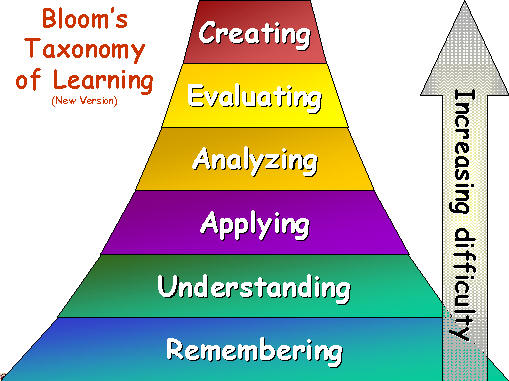
Benjamin Bloom
Bloom's Taxonomy
Bloom created this taxonomy for categorizing levels of abstraction of questions that commonly occur in educational settings. The taxonomy provides a useful structure in which to categorise test questions, since professors will characteristically ask questions within particular levels, and if you can determine the levels of questions that will appear on your exams, you will be able to study using appropriate strategies.
- Knowledge
observation and recall of information, knowledge of dates, events, places, knowledge of major ideas, mastery of subject matter
Question Cues:list, define, tell, describe, identify, show, label, collect, examine, tabulate, quote, name, who, when, where, etc. - Comprehension
understanding information, grasp meaning, translate knowledge into new context, interpret facts, compare, contrast, order, group, infer causes, predict consequences
Question Cues: summarize, describe, interpret, contrast, predict, associate, distinguish, estimate, differentiate, discuss, extend - Application
use information, use methods, concepts, theories in new situations, solve problems using required skills or knowledge
Questions Cues: apply, demonstrate, calculate, complete, illustrate, show, solve, examine, modify, relate, change, classify, experiment, discover - Analysis
seeing patterns, organization of parts, recognition of hidden meanings, identification of components
Question Cues:analyze, separate, order, explain, connect, classify, arrange, divide, compare, select, explain, infer - Synthesis
use old ideas to create new ones, generalize from given facts, relate knowledge from several areas, predict, draw conclusions
Question Cues:combine, integrate, modify, rearrange, substitute, plan, create, design, invent, what if?, compose, formulate, prepare, generalize, rewrite - Evaluation
compare and discriminate between ideas, assess value of theories, presentations, make choices based on reasoned argument, verify value of evidence, recognize subjectivity
Question Cues assess, decide, rank, grade, test, measure, recommend, convince, select, judge, explain, discriminate, support, conclude, compare, summarize
http://www.coun.uvic.ca/learn/program/hndouts/bloom.html
Bloom’s taxonomy was originally created for categorizing levels of concepts commonly used in schools. Taxonomy provides a useful structure that professors can structure their exam questions around. The taxonomy has 6 levels all of which increase with difficulty. Knowledge is the most broad and easier type of question and the question difficulty increases going onto the highest level Evaluation and synthesis. Taxonomy is very useful not only for structuring exam questions, but for the structure of a lesson. It is especially useful for the structure of a lesson for example an ICT class. You start out with basic knowledge and as the lesson progresses, so does the difficulty of the lesson. The taxonomy is extremely useful when it comes to assessing and reporting students. It makes it easier to grade students by putting them into groups/ranks. It can also help control behaviour of the students who seem to be acting out. This may be because they are bored, the teacher can give them harder work and more complex questions. I find Bloom very helpful with structuring a lesson, at the beginning starting with broader information, then further into the lesson you can delve further into the taxonomy getting harder as the lesson progresses.Monday, February 26, 2007

Jean Piaget
Theory of Cognitive Development
While working in Binet's IQ test lab in Paris, Piaget became interested in how children think. He noticed that young children's answers were qualitatively different than older children which suggested to him that the younger ones were not dumber (a quantitative position since as they got older and had more experiences they would get smarter) but, instead, answered the questions differently than their older peers because they thought differently.
There are there are 2 major aspects to his theory: the process of coming to know and the stages we move through as we gradually acquire this ability.
The four development stages are described
- Sensorimotor Stage: from birth to age 2 years (children experience the world through movement and senses and learn object permanence)
- Preoperational Stage: from ages 2 to 7 (acquisition of motor skills)
- Concrete Operational Stage: from ages 7 to 11 (children begin to think logically about concrete events)
- Formal Operational Stage: after age 11 (development of abstract reasoning).
The Developmental Process
Piaget provided no concise (or clear) description of the development process as a whole. Broadly speaking it consisted of a cycle:
- The child performs an action which has an effect on or organizes objects, and the child is able to note the characteristics of the action and its effects.
- Through repeated actions, perhaps with variations or in different contexts or on different kinds of object, the child is able to differentiate and integrate its elements and effects. This is the process of reflecting abstraction (described in detail in Piaget 2001).
- At the same time, the child is able to identify the properties of objects by the way different kinds of action affect them. This is the process of empirical abstraction.
- By repeating this process across a wide range of objects and actions, the child establishes a new level of knowledge and insight. This is the process of forming a new cognitive stage.
- This dual process allows the child to construct new ways of dealing with objects and new knowledge about objects themselves.
- However, once the child has constructed these new kinds of knowledge, he or she starts to use them to create still more complex objects and to carry out still more complex actions.
- As a result, the child starts to recognize still more complex patterns and to construct still more complex objects. Thus a new stage begins, which will only be completed when all the child’s activity and experience have been re-organized on this still higher level.
http://en.wikipedia.org/wiki/Jean_Piaget
The Process of Cognitive Development
Piaget was interested in how an organism adapts to its environment (Piaget described as intelligence.) Behavior (adaptation to the environment) is controlled through mental organizations called schemes that the individual uses to represent the world and designate action. This adaptation is driven by a biological drive to obtain balance between schemes and the environment (equilibration).
Piaget hypothesized that infants are born with schemes operating at birth that he called "reflexes." In other animals, these reflexes control behavior throughout life. However, in human beings as the infant uses these reflexes to adapt to the environment, these reflexes are quickly replaced with constructed schemes.
Piaget described two processes used by the individual in its attempt to adapt: assimilation and accommodation. Both of these processes are used throughout life as the person increasingly adapts to the environment in a more complex manner.
Assimilation is the process of using or transforming the environment so that it can be placed in preexisting cognitive structures. Accommodation is the process of changing cognitive structures in order to accept something from the environment. Both processes are used simultaneously and alternately throughout life. An example of assimilation would be when an infant uses a sucking schema that was developed by sucking on a small bottle when attempting to suck on a larger bottle. An example of accommodation would be when the child needs to modify a sucking schema developed by sucking on a pacifier to one that would be successful for sucking on a bottle.
As schemes become increasingly more complex (i.e., responsible for more complex behaviors) they are termed structures. As one's structures become more complex, they are organized in a hierarchical manner (i.e., from general to specific).

http://chiron.valdosta.edu/whuitt/col/cogsys/piaget.html
Piaget’s theory of Cognitive development, he noticed that children’s answers were quantitatively different from those of older children. There are 2 major aspects to his theory, the process of coming to know and the stages we move through to acquire this knowledge. There are 4 developmental stages, but I have found that in reading about Piaget, Vygotsky is mentioned a fair bit. This to me means that Piaget is useful, but his theory comes together when it is used along side Vygotsky’s theory of social interaction. People assimilate and accommodate to increasingly difficult situations in their life. Piaget’s theory suggests that people move through the stages, but not all people actually reach the final, formal stage in Piaget’s theory. As a teacher I need to focus my lessons on the stage that the students are at, but in the same instance I need to be able to challenge my students so they can reach the next level in Piaget’s theory.

Lev Vygotsky
Cognitive Development, the relationship between language and thinking.
He investigated child development and how this was guided through the role of culture and interpersonal communication. Vygotsky observed how higher mental functions developed through social interaction with significant people in a child's life, particularly parents, and other adults. Through these interactions, a child came to learn the habits of mind of his/her culture. Perhaps Vygotsky's most important contribution concerns the inter-relationship of language development and thought. It establishes the explicit and profound connection between speech (both silent inner speech and oral language), and the development of mental concepts and cognitive awareness (metacognition).
http://en.wikipedia.org/wiki/Lev_Vygotsky
Vygotsky's Social Development Theory
Vygotsky approached development differently from Piaget. Piaget believed that cognitive development consists of four main periods of cognitive growth: sensorimotor, preoperational, concrete operations, and formal operations (Saettler, 331). Piaget's theory suggests that development has an endpoint in goal. Vygotsky, in contrast, believed that development is a process that should be analyzed, instead of a product to be obtained. According to Vygotsky, the development process that begins at birth and continues until death is too complex to to be defined by stages.
Vygotsky believed that this life long process of development was dependent on social interaction and that social learning actually leads to cognitive development. This phenomena is called the Zone of Proximal Development . Vygotsky describes it as "the distance between the actual development level as determined by independent problem solving and the level of potential development as determined through problem solving under adult guidance or in collaboration with more capable peers" (Vygotsky, 1978). In other words, a student can perform a task under adult guidance or with peer collaboration that could not be achieved alone. The Zone of Proximal Development bridges that gap between what is known and what can be known. Vygotsky claimed that learning occurred in this zone.
Therefore, Vygotsky focused on the connections between people and the cultural context in which they act and interact in shared experiences. According to Vygotsky, humans use tools that develop from a culture, such as speech and writing, to mediate their social environments. Initially children develop these tools to serve solely as social functions, ways to communicate needs. Vygotsky believed that the internalization of these tools led to higher thinking skills. When Piaget observed young children participating in egocentric speech in their preoperational stage, he believed it was a phase that disappeared once the child reached the stage of concrete operations. In contrast, Vygotsky viewed this egocentric speech as a transition from social speech to internalized thoughts. Thus, Vygotsky believed that thought and language could not exist without each other.
The Application of the Social Development Theory
Traditionally, schools have not promoted environments in which the students play an active role in their own education as well as their peers'. Vygotsky's theory, however, requires the teacher and students to play nontraditional roles as they collaborate with each other. Instead of a teacher dictating her meaning to students for future recitation, a teacher should collaborate with her students in order to create meaning in ways that students can make their own. Learning
becomes a reciprocal experience for the students and teacher.
The physical classroom, based on Vygotsky's theory, would provide clustered desks or tables and work space for peer instruction, collaboration, and small group instruction. Like the environment, the instructional design of material to be learned would be structured to promote and encourage student interaction and collaboration. Thus the classroom becomes a community of learning.
Because Vygotsky asserts that cognitive change occurs within the zone of proximal development, instruction would be designed to reach a developmental level that is just above the student's current developmental level. Vygotsky proclaims, "learning which is oriented toward developmental levels that have already been reached is ineffective from the view point of the child's overall development. It does not aim for a new stage of the developmental process but rather lags behind this process" (Vygotsky, 1978).
Appropriation is necessary for cognitive development within the zone of proximal development. Individuals participating in peer collaboration or guided teacher instruction must share the same focus in order to access the zone of proximal development. "Joint attention and shared problem solving is needed to create a process of cognitive, social, and emotional interchange" (Hausfather,1996). Furthermore, it is essential that the partners be on different developmental levels and the higher level partner be aware of the lower's level. If this does not occur, or if one partner dominates, the interaction is less successful.
http://chd.gmu.edu/immersion/knowledgebase/theorists/constructivism/vygotsky.htm

Vygotsky observed how mental functions developed with social interactions. His most important contribution is through the inter-relationship between language development and thought. It establishes a connection between speech and the development of metacognition.
People learn in all different ways, there are Gardner’s 8 multiple intelligences and the lessons need to be structured in different ways for all of the class to understand and take in. Students learn by communicating with each other, this is social interaction at its best. For example, on Tuesday we had an ICT class and we had to try and get comments on other people’s blogs. This while it seems easy was quite difficult to master; we all ended up mastering it. If it was not for social interaction it would not have been done. This shows that social interaction is not only important for children, but for adults as well. I think the most important part of Vygotsky’s work is that learning becomes reciprocal, both students and teachers learn off one another. As a teacher you must never assume that you know more than the students, they can also teach you things. I think that this is a very important part of life not just a teacher, but as a person, you can learn anything off anyone not matter what age they are and I think people need to be open to these things.
 William Glasser
People are driven by 6 basic needs.
- Survival
- Power
By understanding the the drives for the 6 basic needs, we become more conscious of the need for our world to be a quality worlds of our choosing.

The 10 Axioms of Choice Theory
- The only person whose behavior we can control is our own.
- All we can give another person is information
- All long-lasting psychological problems are relationship problems.
- The problem relationship is always part of our present life.
- What happened in the past has everything to do with what we are today, but we can only satisfy our basic needs right now and plan to continue satisfying them in the future.
- We can only satisfy our needs by satisfying the pictures in our Quality World.
- All we do is behave.
- All behaviors are Total Behaviors and are made up of four components: acting, thinking, feeling and physiology. All Total Behaviors are chosen, but we only have direct control over the acting and thinking components.
- We can only control our feeling and physiology indirectly through how we choose to act and think.
- All Total Behavior is designated by verbs and named by the part that is the most recognizable
http://raider.muc.edu/~schnelpl/Control%20Theory%20-%20Overhead.html
The 7 Caring Habits
1) Supporting;
2) Encouraging;
3) Listening;
4) Accepting;
5) Trusting;
6) Respecting; and
7) Negotiating differences,
The 7 Deadly Habits
1) Criticizing;
2) Blaming;
3) Complaining;
4) Nagging;
5) Threatening;
6) Punishing; and
7) Bribing or rewarding to control
http://wik.ed.uiuc.edu/index.php/Glasser,_William
Glasser is notable for developing a cause and effect theory that explains human behaviour. His ideas focus on personal choice, personal responsibility and personal transformation.
http://en.wikipedia.org/wiki/William_Glasser
Reality Therapy
Reality Therapy focuses on the here-and-now and how to create a better future, instead of concentrating at length on the past. It emphasizes making decisions, and taking action and control of one's own life.
Reality Therapy is a considered a Cognitive behavioural approach to therapy; that is, it focuses on becoming aware of, and if necessary, change, his/her thoughts and actions.
http://en.wikipedia.org/wiki/Reality_Therapy
Glasser is very important in trying to understand how and why children behave the way, they behave. Glasser’s research shows that children have needs that need to be filled before they can start acting and behaving the way that you as a teacher want them to behave. Glasser’s work is very important to me because it shows that children do not just act out for the sake of acting out, they feel threatened, un-loved etc… There is always a reason for the way people act and I think his work helps us learn how to deal with students who have a problem and we can make them feel better and they then get something out of the lesson. Eventually they start to enjoy coming to class and learning and this makes my job as that teacher easier and more enjoyable, the class tends to then enjoy coming, learning, and they get results from this class. Glasser’s theory focuses on personal responsibility, personal choice, and personal transformation; it is all about the person and the choices they make. It gives control to the person and makes the students take responsibility for their own behaviour. Much like his other theory Reality Therapy, this focuses on how to create a better future instead of concentrating on the past. It emphasizes making decisions and taking action and control of one’s own life. Once again emphasizing the importance of people taking responsibility for their own actions and behaviour. This is very important when it comes to teaching, you can mould and tell students behaviour, but you can’t control it.
Subscribe to:
Comments (Atom)


